Wiring 17 scientific skills into a fresh Antigravity workspace
This is the story I should have told at the Google I/O 2026 hackathon.
I went into that hackathon — Cerebral Valley × Google DeepMind, at
Shack15 on the Embarcadero, May 23rd — wanting to build something
about heat. Not heat in the WBGT-and-clothing-color
sense; the
other story does that already and shipped as
HeatThreshold/HeatThreshold on the day. The story I kept wanting
to tell was the one upstream of that: what does heat actually do
to the molecules inside a human body when core temperature climbs?
Why does 41 °C end an emergency department workup with the words
“organ damage”, when 37 °C is just lunch? What proteins fail first,
how, in what order, with what consequence? I had been reading
HSF1/HSP70 review papers for weeks. I am not a biologist. I knew
the page in my head was the more compelling demo.
I didn’t build it. I built the other one. The molecular story was epistemically risky to ship inside a 48-hour window: claiming anything about human biology under heat stress, on a hackathon stage, with no domain reviewer, is a bad idea. So that idea sat in a README bullet and a Slack message and went quiet. Two days after the hackathon ended I started the repo it should have been — HeatThreshold/heat-protein-lab, MIT, no analytics, no accounts, eight chapters of scrollytelling, one real protein per chapter, every claim back-linked to a real source. It is alive at https://heat-protein-lab.pages.dev/.
It is also a deliberate test of three new(ish) Google products composed against the same brief: Antigravity 2.0, the agentic IDE that’s replacing the Gemini CLI on 2026-06-18; the Science Skills bundle that Google DeepMind dropped a few weeks ago — seventeen skills wired up as Python CLIs covering the major public bio/chem databases; and Stitch, the AI design tool that’s now available as an MCP inside Antigravity. Can these three products, composed by one indie builder at a kitchen table, produce a real, citation-grounded scientific explainer? That’s the demo. The page is the answer.
This first post is about getting from a freshly-opened workspace to
a checked-in data/candidates.json with every database query
verified end to end. That’s Phase 0 in the project plan. It took
about ninety minutes total. Three things made it interesting beyond
a setup exercise.
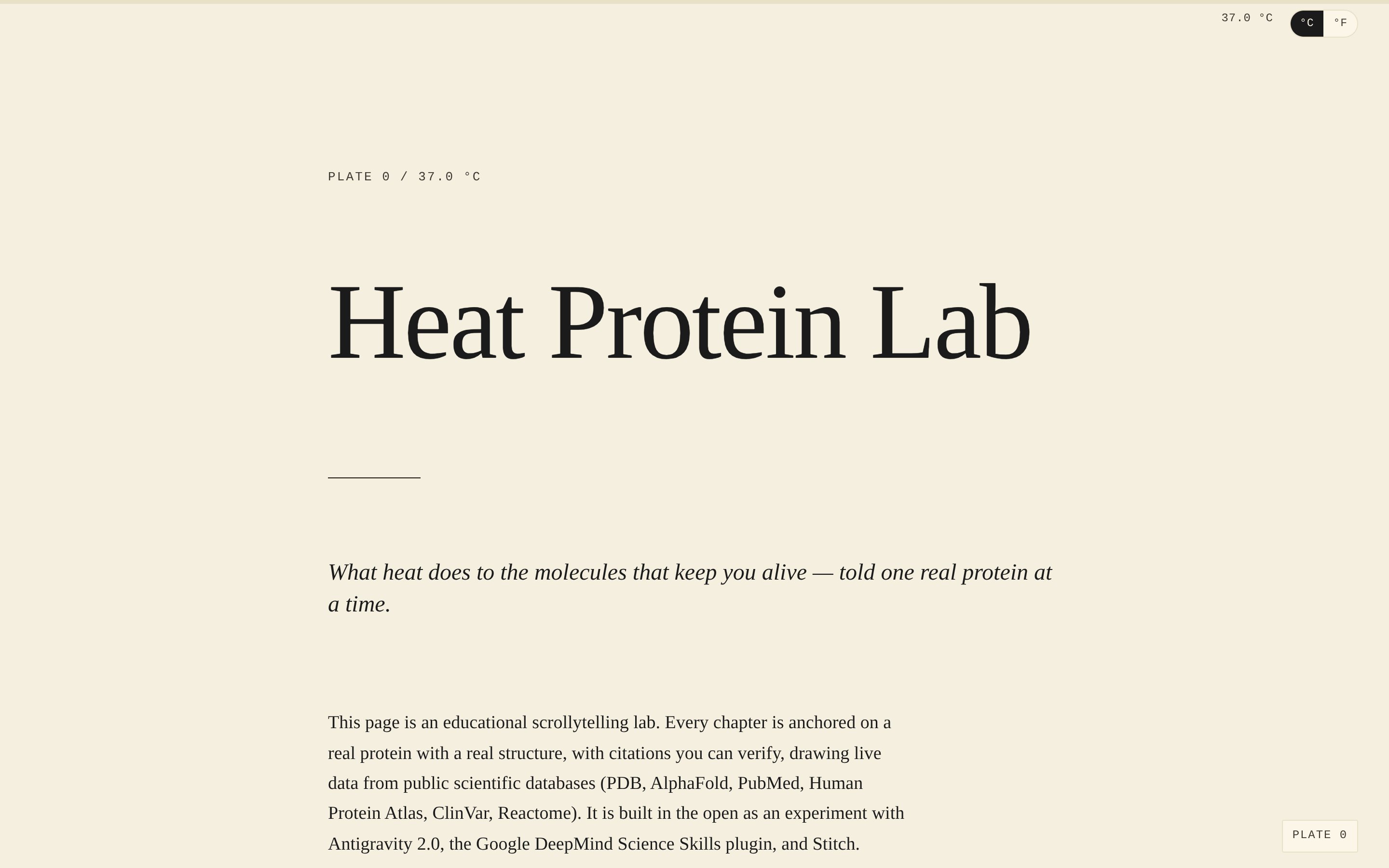 The lab’s landing screen. The page that came out of all this Phase-0 plumbing.
What “verified” actually means
The Science Skills bundle ships seventeen skills. The project needs
six of them: pdb_database, alphafold_database_fetch_and_analyze,
human_protein_atlas_database, pubmed_database, clinvar_database,
and reactome_database. Phase 0 is one trivial call per skill, the
output piped into /tmp/, and the first relevant identifier extracted
and committed to data/candidates.json. Nothing fancy. Just: does the
plumbing work, and can I cite specific things now.
The CLI version of Antigravity is agy (1.0.2 on a Raspberry Pi 5,
aarch64). It works like Claude Code: prompt-driven, with --print for
one-shot non-interactive runs and --dangerously-skip-permissions to
auto-approve tool calls. I started with one mega-prompt: “run all six
smoke tests, then write data/candidates.json with everything you
verified.”
This is the part that taught me a lesson.
Lesson 1: specific small prompts beat orchestration prompts
The mega-prompt sat at 0.0% CPU for fourteen minutes. ps -ef showed
the agy process alive, one outbound socket open, no uv subprocess
ever spawned, nothing written to disk, no stdout output. I went and
made coffee, came back, killed it.
I retried with six separate agy --print calls, each capped at five
lines of output, each carrying the literal uv run scripts/X.py …
command for that skill. They ran in parallel via sibling bash calls
(agy doesn’t appear to share state across processes). All six
returned verified output in under sixty seconds; the first one —
PDB metadata for 4PO2 — produced a clean answer in about thirty
seconds.
The lesson is that when an agentic IDE is asked to plan multi-step work, the planning step can consume the entire LLM call without ever invoking tools. When the same agent is asked to execute a specific tool call, the planning collapses to a single inference and the next inference is the tool call. Same backend, two prompt styles, very different latency curves.
The practical version, for anyone driving the agy CLI:
If a single
agy --printsits at 0.0% CPU for more than sixty seconds with nouv/pythonchild processes visible inps -ef, treat it as stalled andpkillit. Do not wait out the timeout. Rerun with one concrete shell command per prompt.
A separate observation worth recording: in the desktop Antigravity
IDE, the same operator (me, ten minutes earlier) had used Stitch’s
MCP to generate UI mockups for all nine chapters from a single
mega-prompt. That one parallelised cleanly via Python threading
and dropped nine mockups in under two minutes. The “can’t plan”
failure mode appears to be a property of the print-mode CLI
specifically, not the IDE.
Lesson 2: Antigravity bakes API keys into auto-generated scratch
Stitch’s MCP requires a Google API key. When Antigravity called it,
the IDE generated a Python subprocess client at scripts/mcp_client.py
and wrote the key as a literal string in the X-Goog-Api-Key header:
"X-Goog-Api-Key: AQ.Ab8…rjqA"
I caught this one before any git add. Refactored it out of source,
added the path to .gitignore. Two paragraphs later, Antigravity
generated a different Python client at scripts/generate_ui.py
with the same key in the same shape, and my next git add -A swept
it into the commit before I noticed. The commit was local only, never
pushed; a git reset --soft HEAD~1, an unstage, a .gitignore
pattern that catches both file names, a re-commit, and the key never
reached GitHub.
The key has now traveled through my Claude Code conversation history
twice via two embedded-in-source files. It’s rotated. The replacement
will live in ~/.env via a printf | read -s | >> ~/.env recipe
that keeps the value out of any shell or agent context.
The defensive playbook, for any Antigravity workspace touching Google MCPs:
Add up front to
.gitignore:scripts/mcp_client.py,scripts/generate_*.py,scripts/*_client.py. Then before anygit add -A, grep the working tree forAIza|AQ\.[A-Za-z0-9_-]{20,}|API[_-]?KEYpatterns and bail if any match.
This isn’t a knock on Antigravity — the Stitch MCP doesn’t appear to have a standard env-var path documented yet, and the IDE is doing the plausible thing in the absence of one. It is a real ergonomic gap. Worth surfacing.
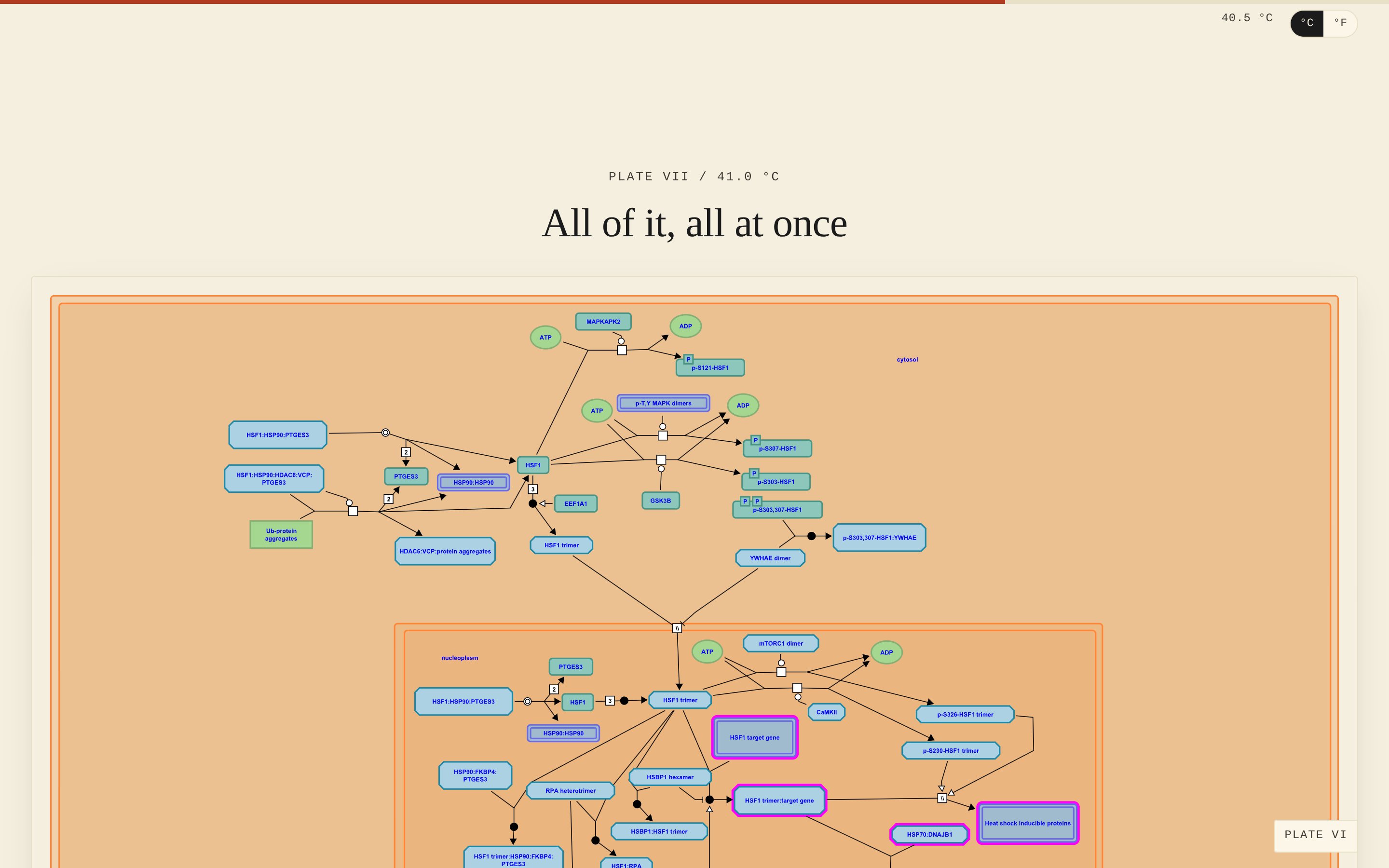 Chapter 7. The Reactome pathway diagram, fetched live through the Science Skills
 reactome_database skill and inlined as SVG with three jump-to-chapter chips below it. The chip ringlights the diagram on hover so a reader can find HSF1, HSPA1A, or HSP90AA1 and trace what role they played a few plates earlier.
Lesson 3: real scientific work fell out the other end
Despite the friction, the actual science output was excellent.
Inside about six minutes of skill execution (after I’d pivoted to
focused prompts), data/candidates.json had:
- PDB
4PO2: verified title “Crystal Structure of the Stress-Inducible Human Heat Shock Protein HSP70 Substrate-Binding Domain in Complex with Peptide Substrate” - AlphaFold
P0DMV8(HSPA1A): global pLDDT 88.88, structure - metadata + PAE downloaded to
data/structures/alphafold/hspa1a/ - Human Protein Atlas for HSPA1A: gene symbol resolved to
Ensembl
ENSG00000204389; Lung tissue at “High” expression - PubMed for “HSF1 trimerization”: top three PMIDs
38537598,24478344,41028522 - ClinVar: 47 variants in
HSPA1A[gene] - Reactome stable ID
R-HSA-3371556confirmed for “Cellular response to heat stress”
Three upstream-worthy bug reports surfaced along the way: the
AlphaFold fetch script returns 403 without a SCIENCE_SKILLS_USER_AGENT
env var; the HPA hpa_cli.py script raises a ValueError in
get-tissue-expression that agy ended up patching in place at
the plugin directory; and the Reactome SVG export needs its
Accept header relaxed. All three are now filed at
google-deepmind/science-skills as issues #2, #3,
and #4.
And a fact worth pinning down for anyone planning a similar project:
the per-skill verification pattern caught a scientific error in my
own design document on the same day. I’d written down “PDB 5D5W
or 5D5U” as candidate human HSF1 structures for Chapter 1. The
pdb_database skill’s metadata query confirmed 5D5U is the human
structure (“Crystal structure of human Hsf1 with HSE DNA”,
2.91 Å) — and that 5D5W is actually a fungal homolog (Chaetomium
thermophilum Skn7). A “yeah it sounds right” candidate that the
verification step caught before any code shipped against it.
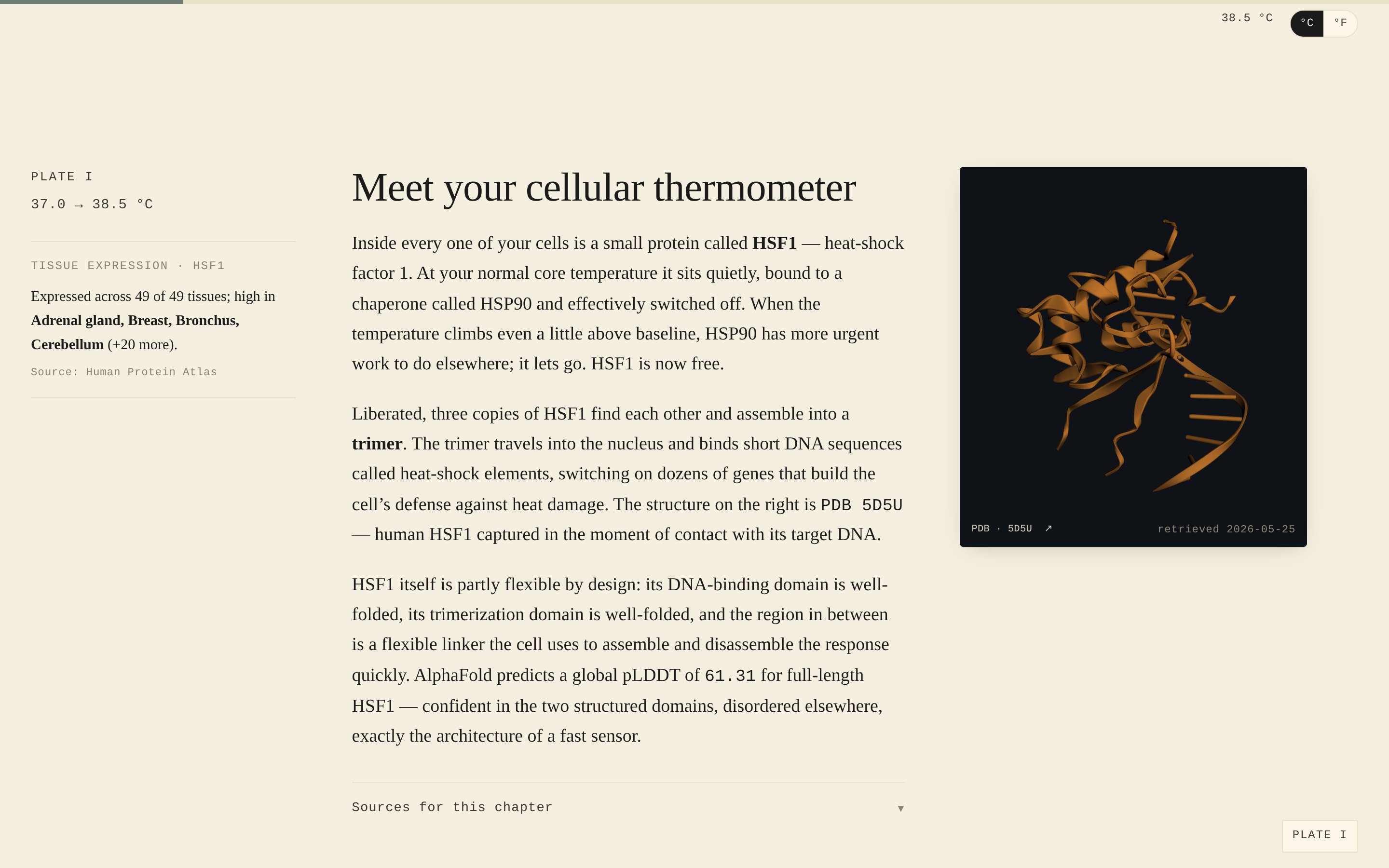 Chapter 1’s first paint. The marginalia column on the left carries the tissue expression badge sourced from the Human Protein Atlas skill; the figure column on the right renders the actual mmCIF file with
 DecompressionStream decoding the committed .cif.gz in-browser. This is what every database query upstream of it is for.
What lands next
Chapter 1’s page now renders the real 5D5U structure in 3Dmol.js, sticky in the figure column, citations pulled live from the three PubMed papers above, the tissue badge rendering Human Protein Atlas data across forty-nine tissues. That’s Phase 1 in the build plan; it’ll be its own writeup. The page is at the repo, license MIT, no medical claims.
If you’re starting your own Antigravity workspace with the Science Skills bundle: open the AGENTS.md in this repo as a worked example for how to brief the IDE on a science project, and prepopulate the gitignore patterns above before your first session. The cost of doing that first is essentially zero. The cost of not is a soft reset.
And if you were at the I/O hackathon and saw HeatThreshold go up:
this is the second half of that story, the part I didn’t trust
myself to ship under a deadline. The lab is at
https://heat-protein-lab.pages.dev/. The repo is at
HeatThreshold/heat-protein-lab. The hackathon retro is
here on craigmerry.com. Read in any order;
they cohere either way.